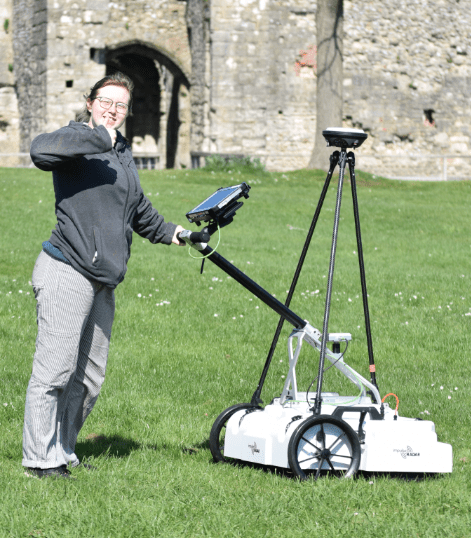
There’s something quietly magical about walking across a site with a magnetometer in hand, knowing that beneath your feet, history is waiting to speak, if only if you’re listening in the right frequency.
Over Easter, I had the opportunity to be part of a geophysical survey at Portchester Castle. For a few days, our team paced carefully across open grass and through sea air, laying out grids and collecting data that would later transform into ghostly outlines of past lives. Unlike excavation, geophysics is a kind of remote conversation with the landscape, one where patience and precision matter more than trowels and trenches.
Portchester is a place layered with stories: a Roman fort, a medieval castle, and even a prison. Its walls tower over the coastline, but our focus was on the quieter ground within and around them. With resistivity, magnetometry, and GPR instruments, we traced subtle shifts in soil composition, searching for anomalies that hint at buried walls, ditches, or structures long since vanished from view.
It’s slow work. Laying tapes. Calibrating machines. Repeating transects until you dream in straight lines. But there’s a rhythm to it. A focus. A kind of meditative attention that fieldwork so often demands.
What I love about survey is how it teaches you to see differently. You begin to notice the slope of a field, the way grass grows unevenly, the slight dip where a wall once stood. You realise that history isn’t just buried – it’s embedded in the present, if you’re trained to catch the signs.
Due to the fact that geophysics is not a destructive process, it was very open to the public. Geophysical survey, especially, is a chance to make our process visible, to show that there’s value not just in what we find, but in how we look for it.
 Knots and Trowels
Leave a comment